There is a particular disappointment that comes about 3 weeks into a free goal tracking app. You have entered your goals, built the structure, connected the habits, and then a panel appears explaining that progress history is a premium feature, or that your trial ends on Thursday. The work is not lost, exactly. It is held hostage.
This is a guide to reading a free plan before you commit a quarter of your life to it, and a plain account of what the EvyOS free plan does and does not include.
"Free" means 3 different things
Nearly every free goal tracking app is one of these. It is worth identifying which before you start entering data.
A trial with a countdown. Full features, fixed number of days. Useful for evaluation, useless as a home for a 12-month goal, because the deadline on the goal outlasts the deadline on the account. If a plan is a trial, treat it as a test drive and keep your real record somewhere else until you decide.
Feature-gated free. You keep the account forever, but the parts that make a tracker work — history, reminders, anything analytical — sit behind the paywall. This is the version that disappoints at week 3, because the free tier is shaped to be almost enough. Check specifically whether past data is readable on the free plan. A tracker you cannot look backwards in is a to-do list.
Quantity-limited free. You keep everything and every feature works, but you can only have so much of it open at once. Nothing expires and nothing is hidden; there is a ceiling.
EvyOS is the third kind. That is a real trade-off rather than a marketing preference, and the rest of this article is about whether the trade suits you.
What the EvyOS free plan includes
| Free plan | |
|---|---|
| Active goals | 2 |
| Active projects | 5 |
| Open tasks | 20 |
| Habits | 5 |
| Skill tracks | 5 |
| Weekly summary | Included |
| Notes, calendar, analytics, connection graph | Included |
| History and past data | Fully readable |
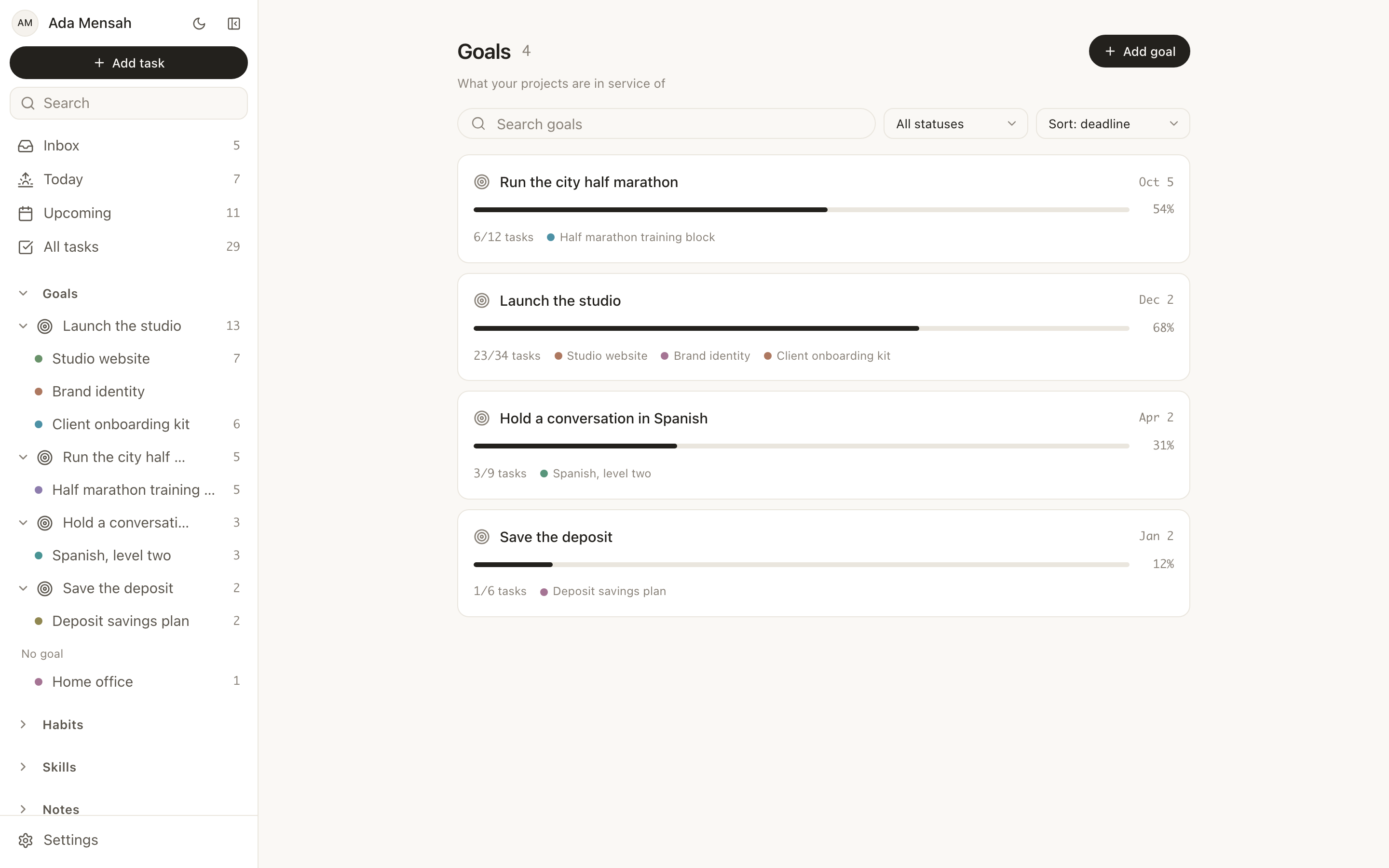
Every record type works the way it works on any plan. A goal is still a goal: category, priority, target date, and milestones with their own dates, with progress calculated from the projects and tasks underneath rather than typed in by hand. A habit still keeps its streak, its strength score and its year-long contribution graph. A task still has 4 priority levels, subtasks, comments, attachments, estimated and actual minutes, tags and recurrence.
The mechanic that makes the limits workable
This is the part people miss, and it changes the maths considerably: the limits count open items only.
20 open tasks does not mean 20 tasks ever. It means 20 unfinished at one time. Tick 6 off this morning and you have 6 slots back this afternoon. The same applies to goals and projects: finish a goal and the ceiling of 2 becomes a ceiling of 1 used.
So the free plan does not ration your year. It rations your simultaneous commitments. Whether that is generous or tight depends entirely on how you work. If you keep 200 someday-maybe tasks in a permanent backlog, 20 open tasks will feel punitive within a day. If you work from a short list and archive aggressively, you may never touch the ceiling.
The limit that binds hardest for most people is 2 active goals, which is deliberate and is also the most useful constraint in the plan. Almost everyone who writes down 7 goals in January is running 2 by March; the difference is that the other 5 spent 8 weeks generating guilt first.
A year on the free plan, concretely
Take someone doing a part-time master's while working. Their 2 active goals are "pass the dissertation" with a target date in June and "get to a 5 km run without stopping" with a target date in November.
Under the dissertation goal: 3 projects — literature review, data collection, writing — each with milestones and a deadline. Under the running goal: 1 project for the training block. That is 4 of 5 project slots.
Habits: reading 45 minutes on weekdays, running on a named-weekday schedule of Tuesday, Thursday and Sunday, and a Sunday review. 3 of 5.
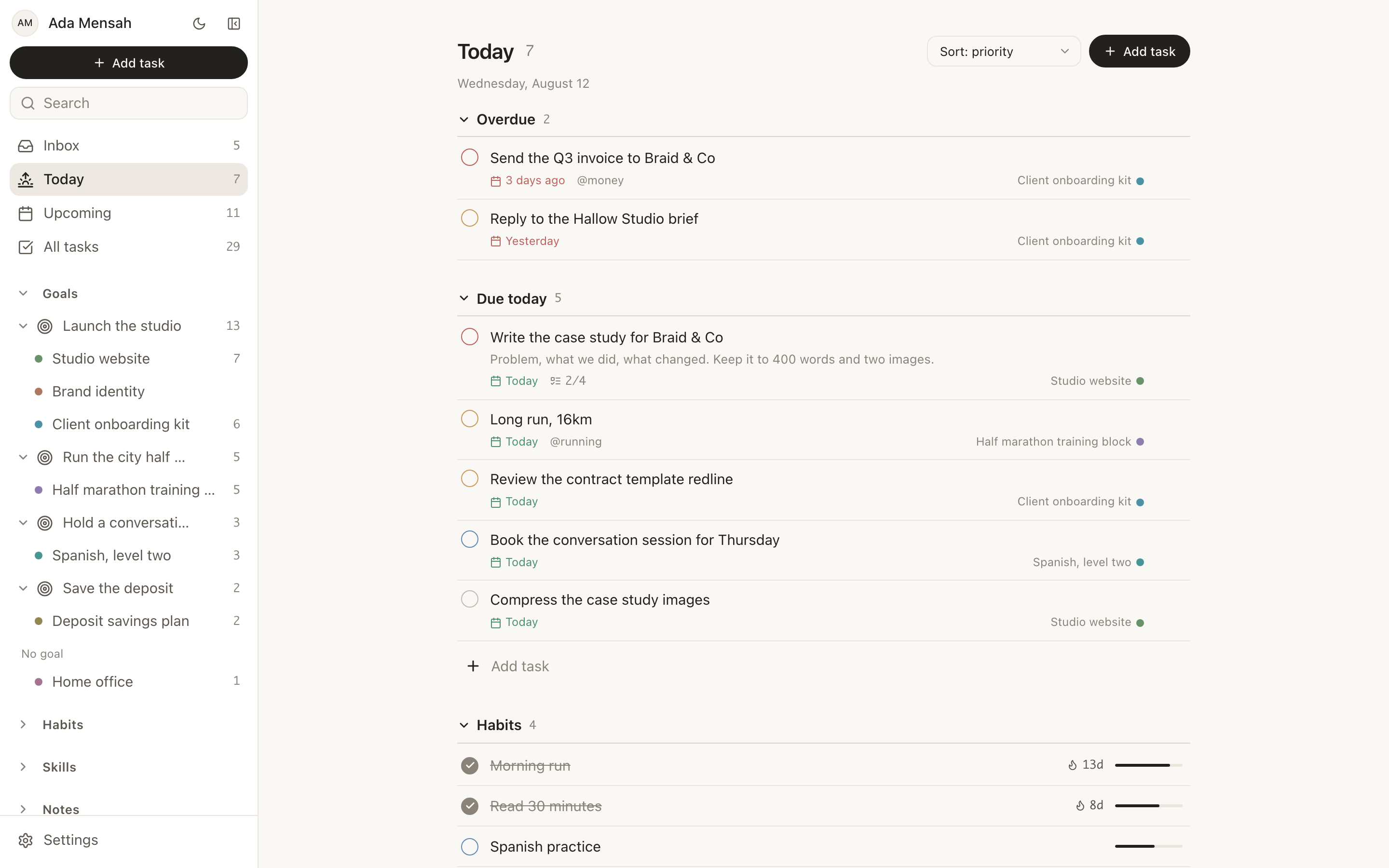
Open tasks stay near 12, because tasks get created a week ahead and closed as they are done rather than hoarded. The Today view puts overdue work at the top, then what is due, then the day's habits, then the calendar, so nothing needs to be hunted for. The structure underneath it — how goals hold projects — is the same on every plan.
In June the dissertation goal is finished. Its slot returns, and the third goal — the one that had been waiting since January — takes its place. Nothing was upgraded and nothing expired.
When free stops being enough
There are 4 honest triggers.
You are running more than 2 real goals at once. Not aspirations. Goals with dates that you would defend in conversation.
Your habit list outgrows 5. People building a routine from scratch often land on 7 or 8. See habits in EvyOS for how the schedules, streaks and strength scores work.
You want to share the system with someone. A shared workspace is a Pro capability. It covers 5 people, then $3 per person per month, and only the subscriber ever pays — the other members do not need their own subscription.
You want to share it. Pro adds shared workspaces, where 5 people keep one set of goals and projects and each keeps their own habit streaks. Everything else — the heatmaps, the analytics and the ChatGPT and Claude connector — is on the free plan too.
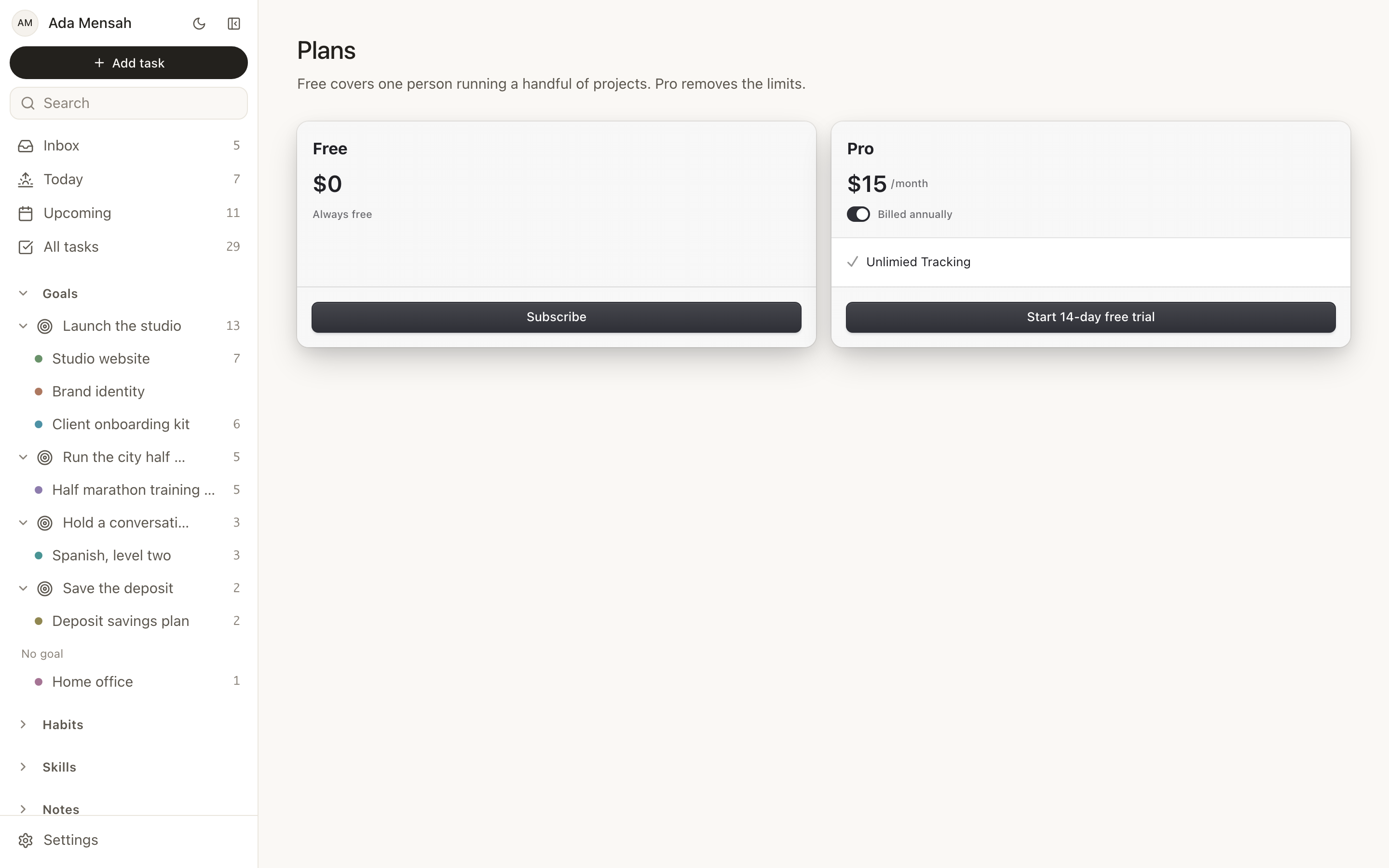
Pro is $15 per month or $144 per year, and removes the ceiling on projects, habits and skills. The full breakdown is on the pricing page.
Free things that need no account at all
If you are not ready to create anything, 3 interactive templates run in the browser and save as you type:
- Goal tracker — the goal, its measure, its deadline and where it honestly stands.
- 90-day goal tracker — one goal, 12 weeks, a score every week including the bad ones.
- Yearly goal tracker — a theme per quarter and a 12-month grid on one page.
Each can be printed or sent into EvyOS later. They are a reasonable way to find out whether you actually want a goal tracking app before you sign up for one, free or otherwise.
Frequently asked questions
Is the EvyOS free plan a trial?
No. It is a plan with quantity limits rather than a countdown. The constraint is on how much is open at once — 2 active goals, 5 active projects, 20 open tasks, 5 habits, 5 skill tracks — not on how long you have had the account.
What happens when I hit a limit?
You finish something. Because the limits count open items, completing a task, project or goal frees the slot immediately. There is no queue and nothing is deleted; you are asked to close something before opening the next thing, which is a reasonable request most of the time and an annoying one occasionally.
Do completed goals still count against the limit of 2?
No. Only active goals count. A goal you finished in March does not occupy a slot in April, and its record, its milestones and everything underneath it remain readable.
Can I read my history on the free plan?
Yes. Analytics, the weekly summary, the year-long habit contribution graph and every past record are available on free. Progress heatmaps are free as well; we go through every visual view in visual goal tracker.
Can 2 people share a free workspace?
No. Shared workspaces are part of Pro. The subscriber's plan covers 5 people, and members 6 and above are $3 per person per month, billed to the subscriber rather than to them. Nobody else in the workspace needs to pay anything.
Is a free goal tracking app good enough long term?
For a lot of people, yes, particularly if you work in short cycles and close things down. The case for paying is usually collaboration or breadth — several habits, several projects, a system shared with a partner — rather than any single missing feature. If you are still deciding between apps rather than plans, the comparison is in the best goal tracker app.